3 Oct: Tigran Asatryan Live
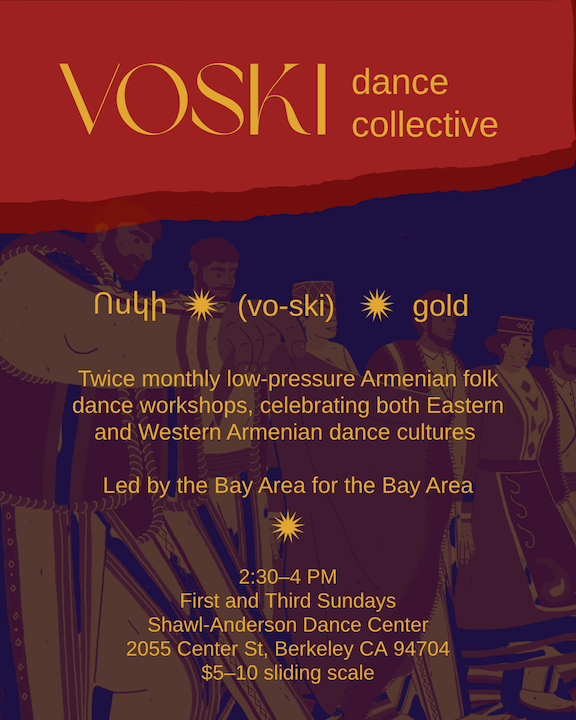
First Sunday: Voski Dance Workshops: Oakland
8 Oct: In the Shadow of Genocide: Female Perpetrators of the Armenian Genocide
In the Shadow of Genocide: Female Perpetrators of the Armenian Genocide
Oct 8 5 p.m.
Sproul Rooms, International House
Abstract
Women are often imagined as victims of war and genocide rather than participants in violence. Yet the genocides of the twentieth century challenged this assumption, revealing that women could also play important roles in persecution and mass killing.
This talk explores a largely overlooked aspect of the Armenian Genocide: the involvement of Turkish women in violence against Armenians. Drawing on Armenian survivors’ testimonies and memoirs, alongside other historical sources, it examines the many ways women participated—from spreading hatred and encouraging violence to looting, abduction, and, in some cases, direct killing. The evidence also points to forms of organized and institutional involvement that deserve further investigation.
By bringing women perpetrators into the story, this talk offers a more complete understanding of how genocide is carried out. It also invites us to rethink common assumptions about gender, violence, and responsibility during one of the twentieth century’s defining atrocities.
Speaker’s Bio
Dr. Edita Gzoyan is a lecturer at the American University of Armenia and Editor-in-Chief of the International Journal of Armenian Genocide Studies. She holds a PhD in International Relations from Yerevan State University and an LL.M. from the American University of Armenia. Her research focuses on the history and legal dimensions of the Armenian Genocide, humanitarian responses and refugee assistance, gender-based violence, forced child transfer, and the post-genocide recovery of Armenian women and children.
8-11 Oct: Other Minds Festival 30
The Other Minds Festival turns 30! On Thursday–Sunday, October 8–11, 2026, our annual showcase for composers will be held at the Brava Theater in San Francisco’s Mission District.
The Festival opens with Joseph Bohigian’sI Am He Whose Life and Soul Are Torment, an evening-length multimedia work about the life of Armenian film director Sergei Parajanov performed by Khatchadour Khatchadourian and Ensemble Decipher. Tara Baghdassarian, art director; Karo Yagjian, costume designer.
On Night 2, the Swiss-born, New York-based Sylvie Courvoisier combines European chamber music and American avant-jazz in a performance for solo piano. Mahsa Vahdat performs original song settings of Persian poetry, accompanied by setar player Atabak Elyasi. Night 2 ends with string quartet music by Juri Seo performed by Friction Quartet.
Night 3 opens with Kristin Norderval and Elizabeth Gaver, who will present a program for voice, live electronics, Hardanger fiddle, and rebec that reflects on historical and contemporary Norwegian-American exchange. Foreign/Domestic – Zachary James Watkins and John Diaz presents a duo of guitar/electronics and drums. The evening ends with an enlivening set of “Blacktronika” from one of the world’s experts: King Britt on live electronics.
At the final concert of OM 30, Charlemagne Palestine, sovereign of embodied minimalism, graces us with a performance for solo piano.
About Other Minds:
Founded in 1993, Other Minds is a leading proponent for new and experimental music in all its forms, bringing together artists and audiences of diverse traditions, generations, and cultural backgrounds. By fostering cross- cultural exchange and creative dialogue, and by encouraging exploration of areas in new music seldom touched upon by mainstream music institutions, OM is committed to expanding and reshaping the definition of what constitutes “serious music.” From festival concerts, weekly radio broadcasts, and the commissioning of new works, to producing and releasing CDs, to archival preservation of thousands of concerts and composer interviews (which OM distributes free on the internet), OM has become one of the world’s major conservators of new music’s ecology.
15 Oct: Edward Said: The Politics of an Oppositional Intellectual
5 p.m.
340 Stephens Hall, 40, Berkeley, CA 94720
Edward Said was one of the most influential intellectuals of the twentieth century. A literary scholar with an aesthete’s temperament, he did not experience his political awakening until the 1967 Arab–Israeli war, which transformed his thinking and led him to forge ties with political groups and like-minded scholars. Said’s subsequent writings, which cast light on the interplay between cultural representation and the exercise of Western political power, caused a seismic shift in scholarly circles and beyond. In this intimate intellectual biography, by a close friend and confidant, Nubar Hovsepian offers fascinating insight into the evolution of Said’s political thought.
Through analysis of Said’s seminal works and the debates surrounding them, Edward Said: The Politics of an Oppositional Intellectual traces the influence of Foucault on Said, and how Said eventually diverged from this influence to arrive at a more pronounced understanding of agency, resistance, and liberation. He consequently affiliated more closely with Raymond Williams, Antonio Gramsci, and more contemporaneously, with his friends the late Eqbal Ahmad and Ibrahim Abu-Lughod.
Said held that it is the intellectual’s responsibility to expose lies and deceptions of the holders of power. A passionate advocate for the Palestinian cause, his solidarity did not prevent him from launching a sustained critique of the Palestinian leadership. Hovsepian charts both Said’s engagement with the Palestinian national movement and his exchanges with a host of intellectuals over Palestine, arguing that Said’s interventions have succeeded in changing the parameters of the discourse in the humanities, and among younger Jews searching for political affiliation.
Drawing on his diaries, in which he recorded his meetings with Said, as well as access to some of Said’s private letters, Hovsepian illuminates, in rich detail, the trajectory of Said’s political thinking and the depth and breadth of his engagement with peers and critics over issues that continue to resonate to this day.
Speaker: Nubar Hovsepian, Associate Professor Emeritus, Chapman UniversityAdmission Information:
Please register for this public book talk via the following link: https://forms.gle/12T27NEX2BpB62A29
16 Oct: Oakland Trex Charity Golf Tournament
17 Oct: St. Gregory Church 60th Anniversary Banquet
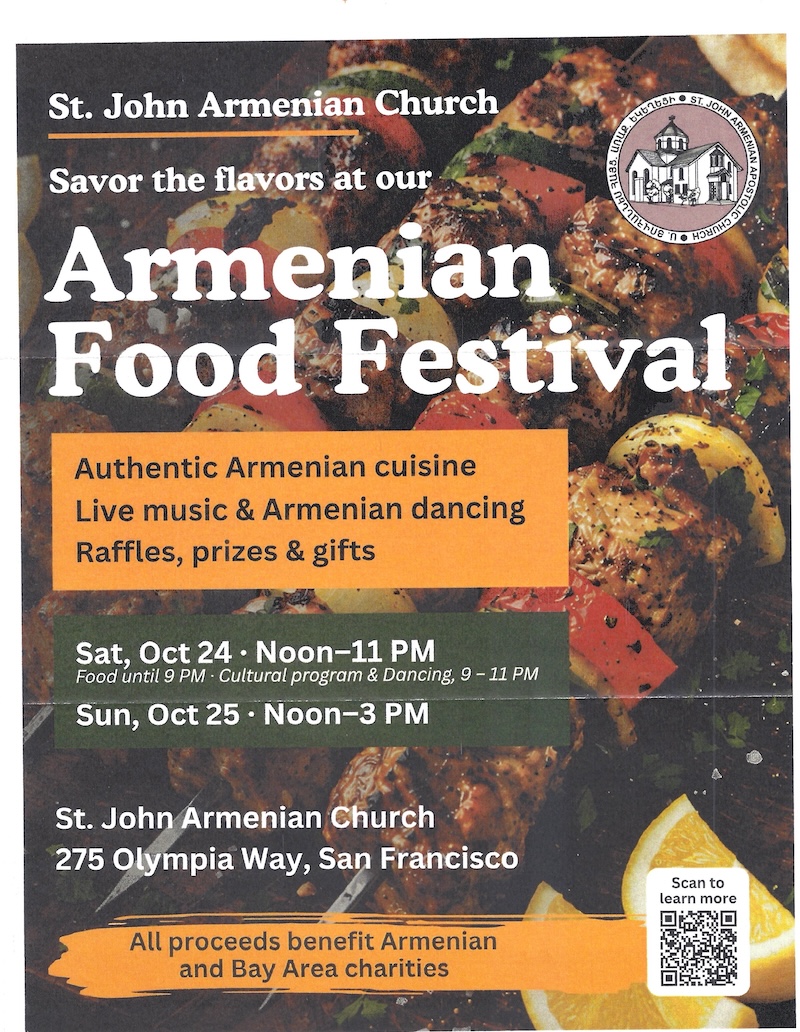
24 25 Oct: St. John Armenian Church Food Festival
Festival Schedule
Saturday, October 24
- Festival open from 12:00 PM to 11:00 PM
- Armenian food served from 12:00 PM to 9:00 PM
- Armenian dancing and musical performances in the evening
- Church tours throughout the day
Sunday, October 25
- Festival opens following Divine Liturgy
- Food, fellowship and festivities continue until 3:30 PM
22 Oct: Lecture | Order of Debt: Power, Wealth, and Death in the Ottoman Empire, 1700–1830
2 p.m. 22 October
Center for Middle Eastern Studies
This talk investigates the relationship between property, capital, finance, and Ottoman statehood in the eighteenth and early nineteenth centuries. It examines the political and financial actors who shaped the accumulation of wealth and power, tracing public and private debts, networks of obligation, and the making of state order between roughly 1700 and 1830. Drawing on Ottoman fiscal records as well as probate and debt inventories that employ distinctive accounting techniques, the talk shows how postmortem estate settlement became a key site where sovereignty, credit, and coercion intersected.
Bio: Dr. Ali Yaycıoğlu is Associate Professor of History at Stanford University and a historian of the Ottoman Empire and modern Turkey whose work examines political economy, law, and state–society relations from the early modern to the modern period. He is the author of Partners of the Empire: Crisis of the Ottoman Order in the Age of Revolutions (2016) and is completing The Order of Debt: Power, Wealth, and Death in the Ottoman Empire. He directs Stanford’s digital history lab, Charting the Empire, which develops tools and data for working with Ottoman fiscal codices and distinctive accounting techniques. His essays on democracy, capitalism, and populism in Turkey appear in Uncertain Past Time: Empire, Republic, and Politics (Istanbul, 2024, in Turkish).
Speaker: Ali Yaycıoğlu, Stanford University
https://events.berkeley.edu/armenian/event/328370-lecture-order-of-debt-power-wealth-and-death-in